Best Speech-to-Text APIs: Deepgram, AssemblyAI, Whisper, Google STT, and Scribe
The best speech-to-text API depends on whether the audio is part of a realtime conversation or a transcription workflow. Start with Deepgram when you need voice-agent ASR, turn detection, interruptions, and low-latency streaming. Start with AssemblyAI when the deliverable is a transcript plus speaker labels, keyterms, summaries, or downstream speech intelligence. Use Whisper when open-source control or self-hosted economics matter. Use Google Cloud Speech-to-Text when procurement, GCP integration, and enterprise controls matter. Use ElevenLabs Scribe when the team already runs voice generation or agents inside ElevenLabs.
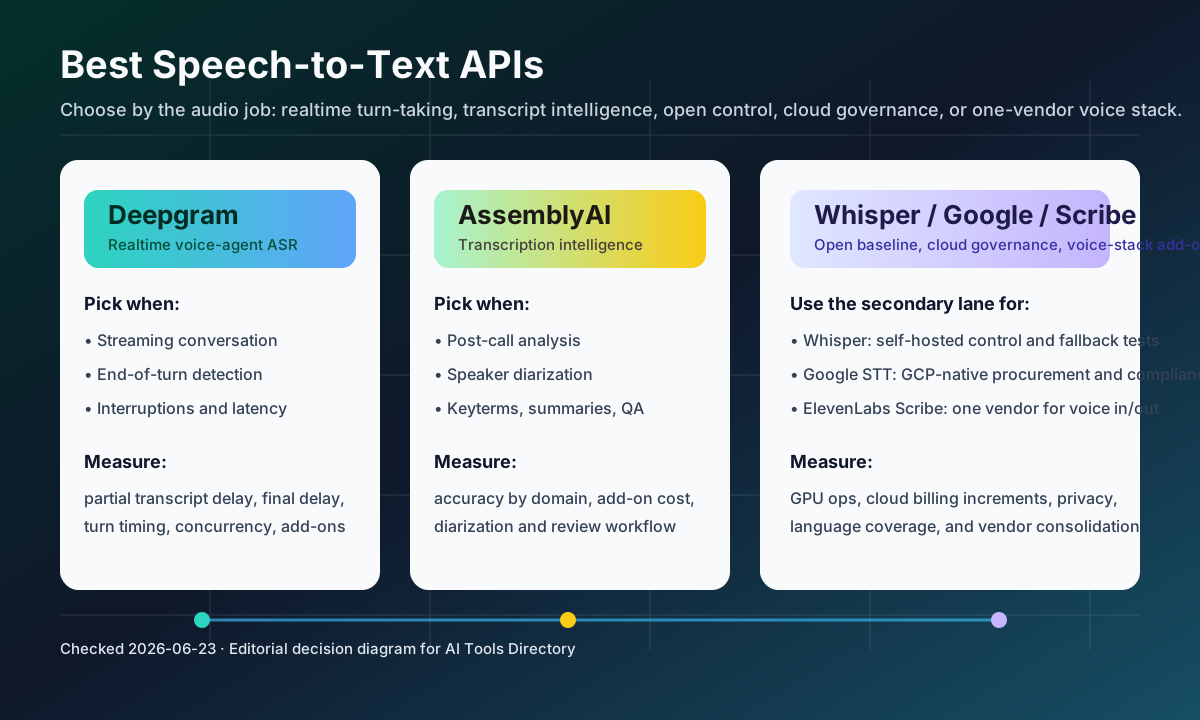
The options compared
| API | Best for | Billing unit |
|---|---|---|
| Deepgram | Realtime voice-agent ASR, turn detection | Per minute (Flux) |
| AssemblyAI | Transcription intelligence, diarization, summaries | Per model (Universal-2 / -3 Pro) |
| Whisper | Open / self-hosted control and economics | Self-hosted GPU cost |
| Google Cloud STT | GCP-native procurement and governance | Per second of audio |
| ElevenLabs Scribe | Teams already in the ElevenLabs voice stack | Per hour (realtime / batch) |
The APIs, one by one
Deepgram is the strongest first test for voice-agent ASR because its current docs describe Flux as a conversational speech recognition model built specifically for voice agents, with model-integrated end-of-turn detection, configurable turn-taking dynamics, natural interruption handling, and ultra-low latency optimized for voice-agent pipelines. Its current pricing page lists Flux English pay-as-you-go pricing in per-minute units, so realtime cost modeling should use call minutes, concurrency, and add-ons rather than transcript count alone.
AssemblyAI is the better first test when the product needs transcription intelligence after the audio has been captured. Its current pricing page lists Universal-2 as the lower-priced pre-recorded model, Universal-3 Pro as the higher-accuracy option for messy multilingual audio, plus add-ons such as keyterms prompting, plain-language prompting, speaker diarization, medical mode, and summaries. That makes AssemblyAI a strong fit for media libraries, sales calls, support QA, podcasts, and compliance review workflows.
Whisper belongs in every shortlist as the open baseline. It is usually not the easiest managed API path, but it gives engineering teams a way to test accuracy, language coverage, self-hosted cost, privacy posture, and fallback behavior before committing fully to a managed vendor. For production, compare GPU cost, batching, monitoring, model updates, privacy controls, and maintenance responsibility against the managed API price.
Google Cloud Speech-to-Text is the procurement-friendly choice when the company already standardizes on GCP. Google documents streaming speech recognition for real-time audio and prices Speech-to-Text by successfully processed audio, measured in one-second increments, with model and volume tiers. Choose it when identity, billing, compliance review, regional operations, and existing cloud contracts matter more than a voice-agent-specific ASR feature.
ElevenLabs Scribe is the practical add-on when the voice workflow already uses ElevenLabs for speech generation, dubbing, or agents. Its current API pricing page lists Scribe speech-to-text pricing per hour and separates realtime Scribe pricing from batch Scribe pricing. That makes Scribe easiest to justify when the team wants one vendor relationship for both speaking and listening, not when it needs the deepest standalone ASR platform.
Frequently asked questions
Which speech-to-text API is best for a realtime voice agent?
Deepgram is the strongest first test: its Flux model is built for voice agents with model-integrated end-of-turn detection, natural interruption handling, and ultra-low latency. For a transcript-plus-intelligence deliverable rather than a live conversation, start with AssemblyAI instead.
Should I self-host Whisper or use a managed API?
Whisper is the open baseline for testing accuracy, language coverage, privacy posture, and self-hosted cost. Before production, weigh GPU cost, batching, monitoring, model updates, and maintenance responsibility against a managed API's price and reliability.
How do I compare accuracy fairly?
Don't rely on generic WER alone. Use third-party AA-WER or Open ASR data for direction, then test on your own audio — noisy short utterances, long-form, overlapping speakers, domain terms, and accents — recording partial/final transcript delay, end-of-turn timing, diarization, and hallucinated words.
A practical benchmark should include noisy short utterances, clean long-form audio, overlapping speakers, domain terms, accents, and a realtime interruption scenario. Record partial transcript delay, final transcript delay, end-of-turn timing, diarization quality, punctuation, hallucinated words, retry behavior, and cost per hour or per minute. Keep human review samples for every vendor because ASR quality differences are often hidden until a specific accent, microphone, or domain vocabulary appears.
Sources and evidence
Sources
- Deepgram docs and pricingChecked 2026-06-23High volatility
Use for plan structure and pricing context as of the check date; verify the official page before purchase.
- AssemblyAI pricingChecked 2026-06-23High volatility
Use for plan structure and pricing context as of the check date; verify the official page before purchase.
- Google Cloud Speech-to-Text pricingChecked 2026-06-23High volatility
Use for plan structure and pricing context as of the check date; verify the official page before purchase.
- ElevenLabs ScribeChecked 2026-06-23High volatility
Use for plan structure and pricing context as of the check date; verify the official page before purchase.
Evidence
- Decision matrixChecked 2026-06-23
An editorial source ledger recording which official pages were checked and on what date — not a measured benchmark.
Methodology