Codex Free Tier Guide: When Free Is Enough and When to Upgrade
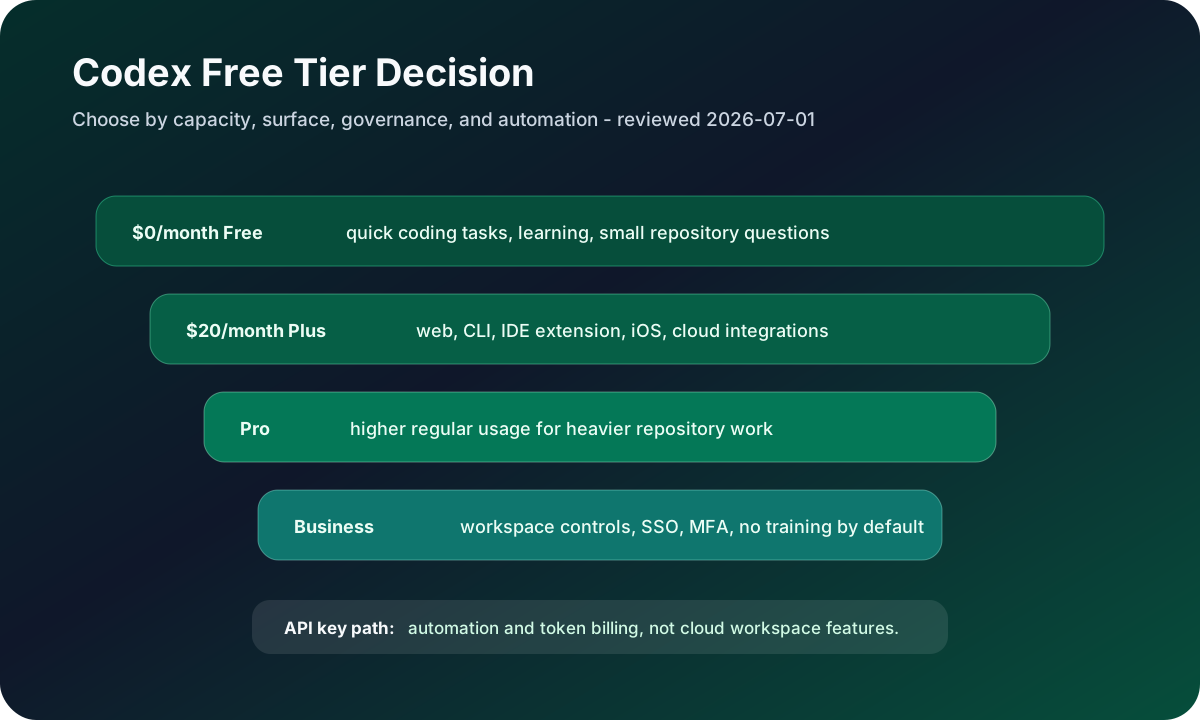
How the free limits actually work
The real question is not whether Codex is free — it is. The question is whether the free limits fit how you actually work. As of April 2026 OpenAI moved Codex off a fixed "messages per window" model and onto token-based usage, so there is no single number like "20 free messages a day" anymore. How far your allowance goes depends on the model you pick, the size and complexity of the task, and whether the work runs locally or in the cloud. A one-file script barely dents your allowance; a long agentic session across a large codebase burns through it fast.
Usage is measured in shared five-hour windows: local CLI messages, web, and IDE all draw from the same window, and additional weekly limits sit on top. So a heavy CLI burst and a heavy web session compete for the same allowance rather than each getting its own. For context, OpenAI publishes paid-tier ranges of roughly 15–80 GPT-5.5 messages per five-hour window on Plus, about 5x that on Pro 5x, and about 20x on Pro 20x. Free is not given a published range because it sits below Plus — treat it as "enough for occasional work, not a full workday of agentic coding."
| Plan | Price | Five-hour window (GPT-5.5) | Best for |
|---|---|---|---|
| Free | $0/month | Lowest of any plan (no published range) | Small edits, single-file questions, learning |
| Plus | $20/month | ~15–80 messages | Regular individual work across web, CLI, IDE, iOS |
| Pro 5x / 20x | From $100/month | ~5x / ~20x the Plus range | All-day, near-full-time agentic coding |
| Business | $20/user/mo (annual) | Shared, plus admin governance | Teams needing SSO, controls, shared workspace |
| API key | Per-token | No window — billed by usage | CI, scripts, automation |
When to move off Free — and to which plan
Plus at $20/month is the first paid step for most individual developers, and the jump you make when Free's window keeps interrupting you. Beyond raising limits, Plus adds Codex across web, CLI, IDE extension, and iOS, plus cloud integrations like automatic code review and Slack. Pro starts from $100/month with 5x or 20x rate-limit options and is the tier for people running Codex as a near-full-time agent. When even Plus's window pinches, Plus and Pro users can also buy additional credits rather than upgrading a whole tier.
Business is the path when the decision stops being personal. OpenAI lists Business at $20/user/month billed annually (or $25/user/month monthly) for 2+ users, with shared Codex access, larger virtual machines for cloud tasks, admin controls, SAML SSO, MFA, and no training on business data by default. Choose it for the governance and shared workspace, not just for more messages — if a single person needs raw capacity, Pro is usually the cheaper answer.
An API key is a different product, not a bigger free tier. API-key Codex runs in the CLI, SDK, or IDE extension and bills per token at standard API rates, so it never hits a five-hour window — but it also drops the ChatGPT-plan cloud features like GitHub code review and Slack. Reach for it when you want Codex inside CI, scripts, or automation where predictable per-token billing beats a shared human-usage window. For interactive daily coding, a subscription is usually simpler and cheaper.
Frequently asked questions
Is Codex free forever, or just a trial?
It is free on an ongoing basis, not a time-limited trial — the Free plan permanently includes Codex at $0/month. What changed is that the temporary boost to free-tier limits ended, so today's Free ceiling is lower than it was during the promotion.
Can I do real project work on the free tier?
Yes for small, bounded work — single-file edits, reading and explaining code, quick fixes, and learning the agent loop. No for sustained full-day agentic sessions on a large repo, where you will hit the shared five-hour window and want Plus or Pro.
How do I check how much free usage I have left?
Run /status in an active Codex CLI session, or open the Codex usage dashboard. Because usage is token-based, the same number of messages can consume very different amounts depending on task size and model.
Is the API key cheaper than a subscription?
It depends on volume. For CI and automation the per-token API bill can be lower and more predictable; for interactive daily coding a Plus or Pro subscription is usually simpler and cheaper than paying per token, and it keeps cloud features like code review and Slack.
Sources and evidence
Sources
- OpenAI Codex pricingChecked 2026-07-07High volatility
Use for Codex plan availability and the April 2026 move to token-based usage; window ranges and credits are volatile.
- OpenAI Codex plan documentationChecked 2026-07-07High volatility
Use for plan structure and pricing context as of the check date; verify the official page before purchase.