Best Low-Latency TTS API: Cartesia, ElevenLabs, OpenAI TTS, and Azure
The best low-latency TTS API for a realtime voice agent is usually Cartesia Sonic when first-audio speed and interruptible conversation are the main constraints. If you also need a broad voice library and cloning workflow, test ElevenLabs Flash v2.5 beside it; if your stack is already OpenAI-first, start with OpenAI TTS or the live audio path; if governance and multilingual enterprise coverage matter more than raw first-byte speed, compare Azure AI Speech. Fish Audio and Chatterbox belong in the second pass when pay-as-you-go economics, creator cloning, or open deployment matter.
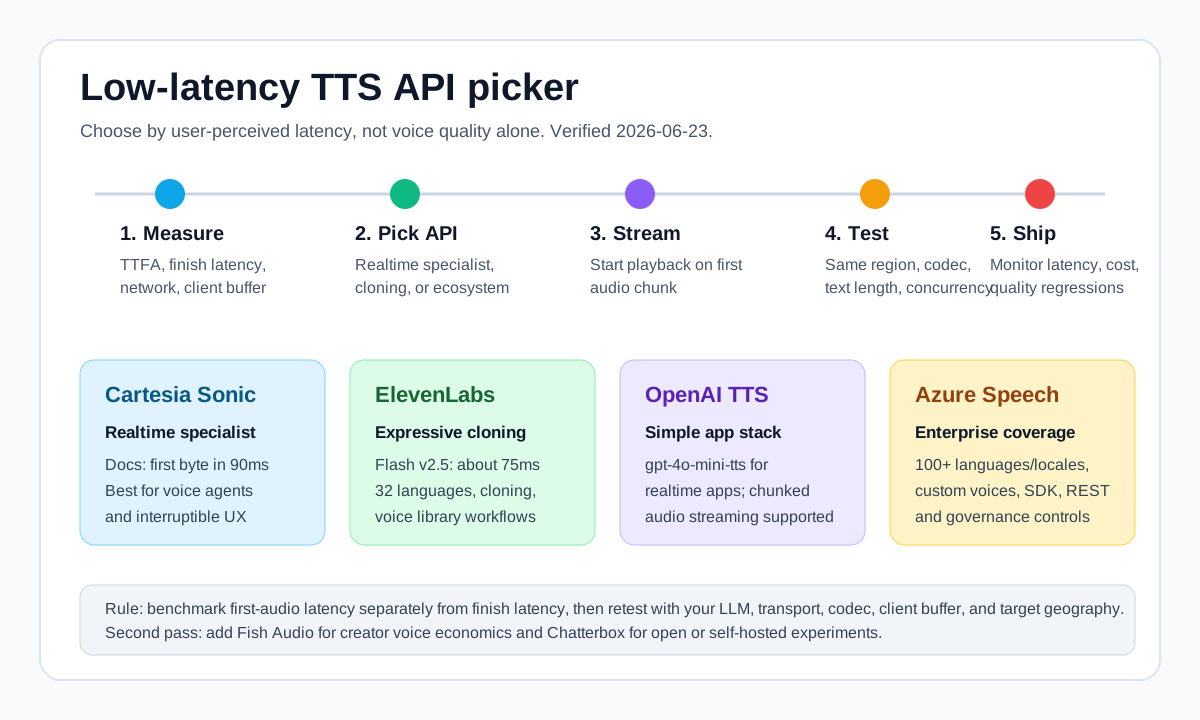
For low-latency TTS, first-byte or first-audio latency matters more than total file generation time because the user can begin hearing speech before the full response is complete. Microsoft Azure's latency guide makes the same distinction: first-byte latency is usually lower than finish latency, and streaming is critical because playback can begin when the first audio chunk arrives.
The options compared
| Provider | Latency / model | Pricing posture | Best for |
|---|---|---|---|
| Cartesia | ~90ms first byte (Sonic 3.5) | Usage-based | Realtime, interruptible voice agents |
| ElevenLabs | ~75ms (Flash v2.5), 32 langs | $0.05 / 1K chars (Flash/Turbo) | Expressive cloned voices + low latency |
| OpenAI TTS | gpt-4o-mini-tts / tts-1 streaming | Per OpenAI API | OpenAI-native product stacks |
| Azure AI Speech | Finish-latency focus, 100+ locales | Per-char; Free F0 0.5M chars/mo | Multilingual enterprise + governance |
| Fish Audio | Not latency-first | Pay-as-you-go, per UTF-8 byte | Creator cloning + long-form economics |
| Chatterbox | Self-hosted, realtime synthesis | Open source (MIT) | Open / on-prem deployment control |
The providers, one by one
Cartesia is the clearest first test when the query is specifically low latency TTS API. Cartesia's current docs say Sonic 3.5 can stream the first byte of audio in 90ms and position Sonic for realtime conversational experiences, dubbing, narration, and AI avatars. That makes it the most direct match for interruptible assistants, phone agents, and avatar products where silence after the LLM answer feels broken.
ElevenLabs is the better first test when latency is important but voice quality, cloning, and creator-facing voice workflows are just as important. Its current docs list Flash v2.5 as the low-latency model for realtime applications, with about 75ms latency, 32 supported languages, and a 40,000 character limit. Its API pricing page lists Flash/Turbo TTS at $0.05 per 1K characters, so cost modeling should use character volume as well as plan allowances.
Fish Audio is not the lowest-latency specialist in this shortlist, but it is useful when creator voice cloning and simple usage-based billing are the main constraints. Its current developer pricing says API access is pay-as-you-go with no subscription fees or monthly minimums, and both current TTS model lines are priced per UTF-8 byte rather than per character plan bundle. That makes Fish Audio worth modeling when long-form volume and voice cloning economics are the question.
Chatterbox is the open or self-hosted path rather than a hosted API default. Resemble AI describes Chatterbox as open source and MIT licensed, with zero-shot voice cloning, emotion control, realtime voice synthesis, and on-premise deployment. Treat it as an engineering option for teams that can operate models, manage GPU capacity, and accept more implementation responsibility in exchange for control.
OpenAI TTS fits when the product already uses OpenAI models and the team wants the simplest integration path. OpenAI's speech docs recommend `gpt-4o-mini-tts` for intelligent realtime applications, note that `tts-1` has lower latency than `tts-1-hd` at lower quality, and document realtime audio streaming with chunk transfer encoding. For a full speech-to-speech agent with barge-in and natural turn taking, OpenAI points builders toward the live audio API path rather than a TTS-only pipeline.
Azure AI Speech is not the page's lowest-latency specialist pick, but it belongs in the shortlist for enterprise voice products and azure ai speech text to speech pricing free tier searches. Microsoft documents standard neural voices across 100+ languages and locales, Free F0 Neural Text to Speech at 0.5 million characters per month, custom voice options, Speech SDK and REST access, SSML controls, and per-character billing. Choose Azure when regional deployment, compliance expectations, custom branded voice governance, and existing Azure infrastructure outweigh shaving another few milliseconds from first audio.
A practical benchmark should send the same short prompt, same paragraph-length prompt, and same interruption-prone dialog turn to every vendor from the same region. Record time to first audio, time to usable playback, finish latency, audio duration, sample rate and codec, websocket or HTTP behavior, retry behavior, and cost per 1,000 characters or per minute. Then repeat under concurrency, because a provider that feels fast in a single request may behave differently at call-center volume.
Frequently asked questions
What is the lowest-latency TTS API?
By vendor claims, Cartesia Sonic (~90ms first byte) and ElevenLabs Flash v2.5 (~75ms) lead for first-audio speed. But advertised latency is only one piece — LLM generation, region, codec, transport, buffering, and concurrency often dominate what the user actually hears, so benchmark in your own stack.
Which TTS API is best for enterprise and multilingual?
Azure AI Speech: 100+ languages/locales, a Free F0 tier at 0.5M characters/month, custom branded voice governance, SSML, and regional deployment. Choose it when compliance and existing Azure infrastructure matter more than shaving a few milliseconds off first audio.
How should I benchmark latency myself?
Send the same short prompt, paragraph-length prompt, and interruption-prone dialog turn to every vendor from the same region. Record time to first audio, usable-playback time, finish latency, codec/sample rate, transport behavior, and cost per 1K characters — then repeat under concurrency.
A low-latency TTS API is a speech synthesis service that can begin streaming audio quickly enough for conversational interfaces. For voice agents, prioritize first-audio latency, streaming playback, interruption handling, codec support, region placement, and stable performance under concurrency; for narration or audiobooks, prioritize long-form quality, editing controls, rights, and total cost instead.
Sources and evidence
Sources
- Cartesia pricingChecked 2026-06-25High volatility
Use for plan structure and pricing context as of the check date; verify the official page before purchase.
- ElevenLabs API pricingChecked 2026-06-25High volatility
Use for plan structure and pricing context as of the check date; verify the official page before purchase.
- Azure Speech pricingChecked 2026-06-25High volatility
Use for plan structure and pricing context as of the check date; verify the official page before purchase.
- Fish AudioChecked 2026-06-25High volatility
Use for plan structure and pricing context as of the check date; verify the official page before purchase.
- Chatterbox model pageChecked 2026-06-25Medium volatility
Use for official product positioning and documented capabilities as of the check date.
Evidence
- Decision matrixChecked 2026-06-25
An editorial source ledger recording which official pages were checked and on what date — not a measured benchmark.
Methodology